Tutorial 13 of 14
Radioactive decay, gases and pH in the Element Lab
Intermediate 12 min
Calculate half-lives, activities and decay chains, compare real and ideal gases, design buffers and draw titration curves with the Element Lab notebook cells.
Three more cells belong to the Element Lab: Radioactive decay, Gas laws and pH, buffers and titration. They accept values with units, show every step as figures and tables, and run the same engines as the tool pages Half-Life, Activity & Decay Chain Calculator, Gas Law Calculator: Ideal, van der Waals & Combined and pH, Buffer & Titration Curve Calculator. Open the Element Lab template (Notebook → Templates…) and press Run all to follow along. The first part, The Element Lab, covers the periodic table.
1. How much is left after 30 days?
The Iodine-131 after 30 days cell uses Calculation: Amount and activity after a time, the nuclide Iodine-131 (8.0252 d), Starting amount 100 MBq and Elapsed time 30 d. The result: 7.493 % remains, which is 3.738 half-lives. The activity is down to 7.4935 MBq, which is only 1.63 ng of iodine. A table lists the amount after each whole half-life, and the chart shows activity over time.
Under Continue with, How long until 1 % is left? adds a variant in Time to decay to a level mode. The answer is 53.3 days, which is log₂ 100 = 6.64 half-lives.
Starting amounts can be a percentage, an activity (Bq, MBq, Ci, mCi), a mass (for preset nuclides) or a number of atoms. Times take s, min, h, d or y.
2. Follow a decay chain
The Mo-99 → Tc-99m generator cell uses Calculation: Decay chain (Bateman) with the preset chain. Hospitals get technetium-99m for scans this way: molybdenum-99 (2.75 days) decays to Tc-99m (6 hours). The chart shows the Tc-99m activity growing in, peaking 22.847 h after a fresh start, and then following its parent in transient equilibrium. Only 87.6 % of Mo-99 decays feed Tc-99m, so its activity settles slightly below the parent's.
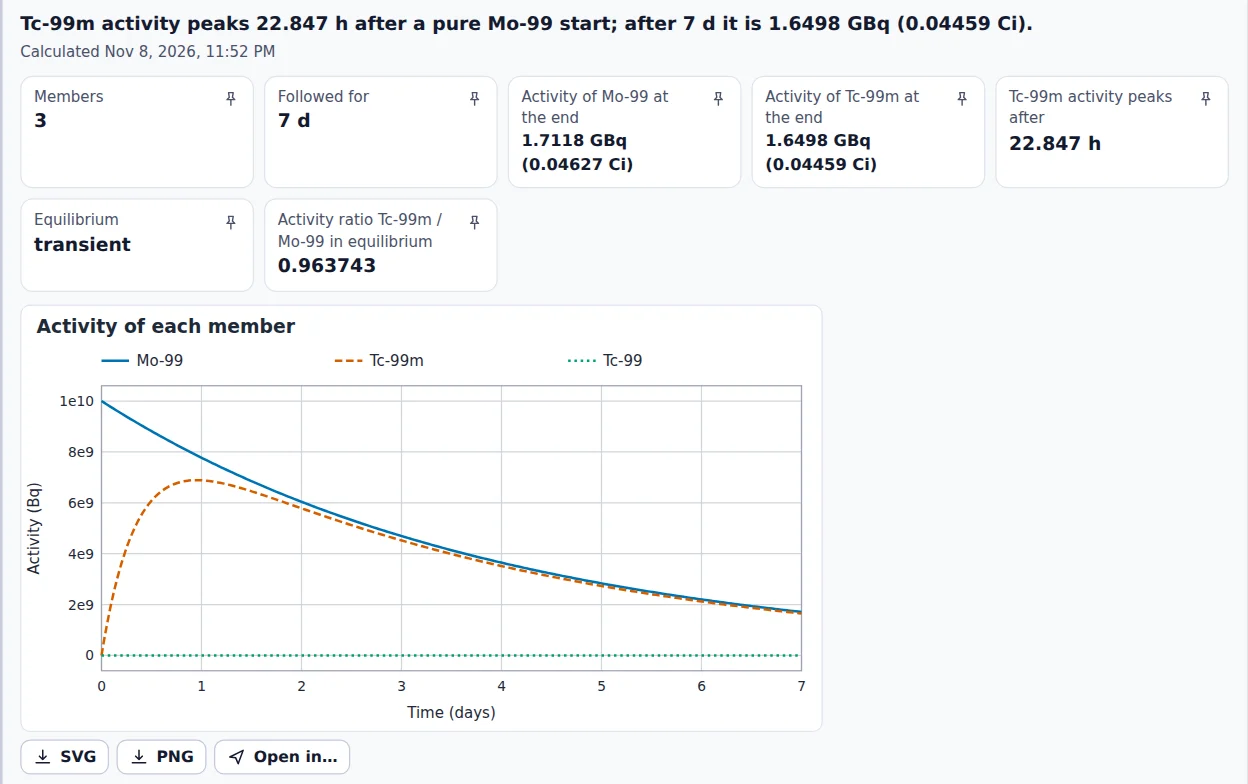
Choose My own chain (enter it below) to type a chain yourself, one member per line: Mo-99 65.976 h, then Tc-99m 6.0067 h 0.876 (the last number is the branching share), then Tc-99 stable. With Half-life from measurements you paste your own counts (0 h 1000, 6 h 501 …) and get the fitted half-life with its standard error and the closest known nuclide.
3. A real gas next to the ideal one
The CO₂ in a 1 L flask at 300 K cell uses Gas law: van der Waals (real gas) with carbon dioxide. Pressure is left empty, so that is the value calculated. The answer is 2240.34 kPa, while an ideal gas would give 2494.34 kPa. The compressibility factor Z = 0.898 is below 1, so attraction between the molecules wins. Because 300 K is just under CO₂'s critical temperature of 304.1 K, a warning says the gas could condense here. The isotherm chart puts the van der Waals curve next to the ideal one: at small volumes the real gas needs far less pressure.
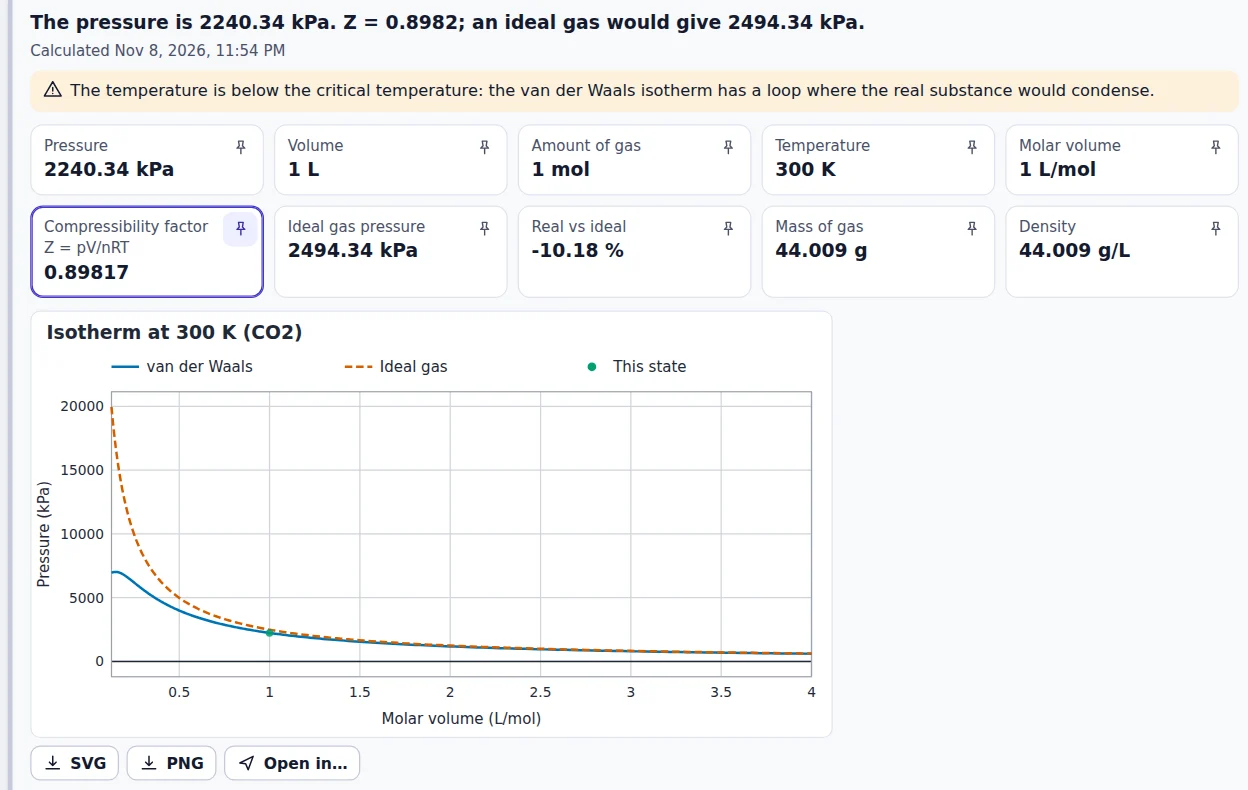
Leave a different field empty to solve for it: volume, amount or temperature. The Ideal gas p·V = n·R·T mode gives the familiar 22.414 L for one mole at 1 atm and 0 °C. The Combined gas law mode takes two states of the same sample: leave exactly one of the six values empty.
4. Buffers: pH, recipe and capacity
The Acetate buffer, then 1 mmol HCl cell mixes 0.1 M acetic acid with 0.1 M sodium acetate in 100 mL. pH (exact) is 4.76, the same as the Henderson–Hasselbalch value. The buffer capacity is 0.115 mol/(L·pH). After Add strong acid 1 mmol, the pH falls only to 4.67. The recipe table says what to weigh: 0.601 g of acetic acid and 0.820 g of sodium acetate. The Molar masses of the buffer components cell below checks those molar masses with the chemistry engine.
For a recipe, leave Weak acid [HA] and Conjugate base [A⁻] empty and enter a Target pH (recipe). With Buffer acid set to phosphate and target 7.4 you get 0.0386 M NaH₂PO₄ and 0.0614 M Na₂HPO₄.
5. Draw a titration curve
The Titration of acetic acid with NaOH cell uses Calculation: Titration curve, a Weak acid, titrated with NaOH sample with Ka 1.8e-5, 25 mL at 0.1 M and 0.1 M titrant. The equivalence point is at 25 mL with pH 8.72, alkaline because acetate is a weak base. At half equivalence the pH is 4.75, equal to the pKa. The cell suggests phenolphthalein and thymolphthalein, whose colour changes fall inside the steep jump.
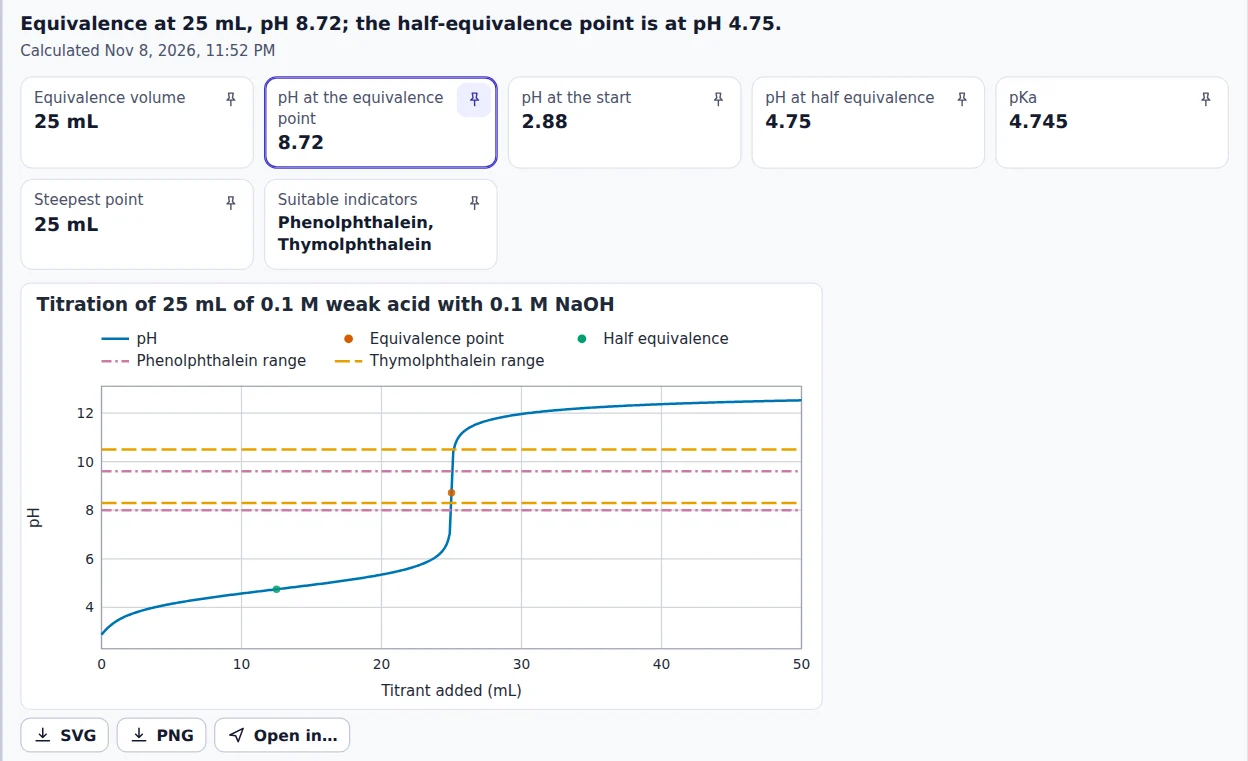
Switch Sample to a strong acid and the equivalence pH becomes exactly 7.00. A weak base such as ammonia (pKb 4.75) is titrated with HCl.
These cells calculate with ideal concentrations at 25 °C. Real solutions differ by a few tenths of a pH unit, so always check with a calibrated meter. The decay cells calculate amounts only, not radiation doses.
Ready to try it?